


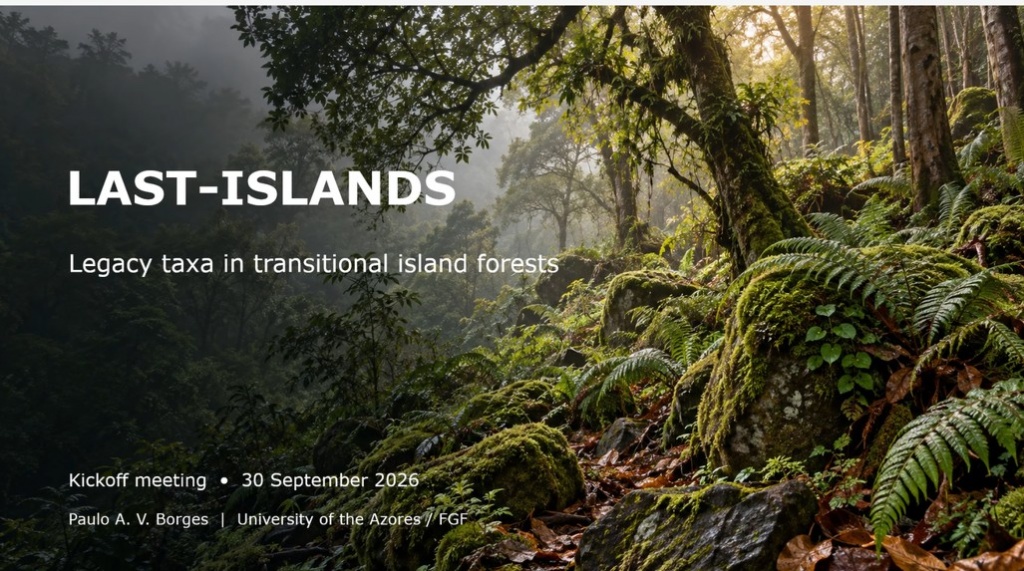
LAST-ISLANDS seeks to discover where rare endemic species survive in exotic forests of the Azores
- October 9th, 2026
- Biodiversity
- Print Article
A project led by the Gaspar Frutuoso Foundation and the University of the Azores, with support of up to 300,000 euros from the Belmiro de Azevedo Foundation, will spend three years studying the persistence of native and endemic species in exotic forests and transitional habitats across several Azorean islands.
When a rare species persists in a human-altered forest, does it mean it has found a lasting refuge, or is its population on the path to extinction? This is one of the central questions of LAST-ISLANDS – Legacy tAxa Survivors in Transitional ISLAND Systems. This scientific project launches in the Azores at the end of September and aims to understand the conditions under which native and endemic species can persist in exotic forests and other habitats in transition.
The project is led by the Azores Biodiversity Group of the University of the Azores, part of the CE3C– Centre for Ecology, Evolution and Environmental Changes, and is coordinated by researcher Paulo Borges. With a duration of 36 months, LAST-ISLANDS receives financial support of up to 300,000 euros from the Belmiro de Azevedo Foundation, through a collaboration protocol with the Gaspar Frutuoso Foundation and the University of the Azores.
LAST-ISLANDS stems from a question with direct implications for biodiversity conservation: can exotic forests and transitional habitats function as true refuges for native species, or are they merely sustaining residual populations that could disappear in the future? The project aims to distinguish between populations with the capacity to persist and isolated populations that may be facing a so-called "extinction debt."
The research will use existing data concentrated on Terceira Island as a baseline and will be expanded to the islands of São Miguel, Santa Maria, São Jorge, Pico, and Flores, covering different contexts of exotic forests and transitional habitats. The study will pay particular attention to spiders, beetles, and bryophytes, integrating ecological, landscape, taxonomic, and genetic data.